Free preview
Read the cover, table of contents, and full first chapter of Vibe Code Like an Engineer: How Software Actually Works, a practical book for non-technical builders using AI.
Vibe Code Like An Engineer
How Software Actually Works
Bruno Freitas
Table of Contents
Preface
Why I wrote this guide and why it might help you.
1. Why AI Code Breaks (and How to Prevent It)
Learn why AI-generated systems feel finished even when they are structurally fragile. “It works on my computer” is only the beginning.
2. The Mental Model Every Software Engineer Uses
Understand how modern software is structured so you can reason about what you're building, communicate confidently with engineers, and make better technical decisions.
3. Why Real Software Fails
Learn to recognize the failure patterns behind most incidents so you can anticipate problems before your users discover them.
4. How to Think Like an Engineer
Learn the principles experienced engineers use to balance speed, simplicity, maintainability, and long-term reliability.
5. How to Ship Software with Confidence
Understand how reviews, testing, and deployment pipelines reduce risk so you can ship changes with confidence instead of hope.
6. Seeing What Your Users See
Learn how to investigate production systems using logs, metrics, and observability so you can diagnose real-world problems quickly.
Conclusion
Why what you learned will make you a better builder in the age of AI.
About the Author

Bruno Freitas is a software engineer working at the intersection of AI systems and production infrastructure.
He began experimenting with large language models in 2022, before ChatGPT was publicly released, and quickly became interested not only in what these systems could generate, but in how they behaved once used in real environments.
He has worked on large-scale production systems at Coinbase, Amazon and Jusbrasil (the largest legal website in the world). His experience spans AI-powered applications, backend services, cloud infrastructure, and distributed systems operating under real-world constraints.
Bruno has also contributed to research in artificial intelligence, with recognized academic work in the field, and has participated in global technology initiatives such as NASA’s International Space Apps Challenge, where he was part of a globally awarded team.
Across startups, research environments, and large engineering organizations, he repeatedly observed the same tension: building software is becoming dramatically easier, but understanding the systems behind it remains rare.
This guide is the result of that observation.
It is written for builders who move fast with AI tools but want to stay structurally grounded in what they are actually creating.

Check his LinkedIn using the link above for more information.
Feedback or questions about this guide are also greatly appreciated.
Preface
GPT before the Chat
“The most dangerous phrase in the language is, ‘We’ve always done it this way.’”— Grace Hopper
In mid-2022, during an interview for an engineering role at an AI company, the researcher I was speaking with shared his screen. He opened a simple text box, typed a prompt for a cake recipe, and watched as the text appeared. Then, he asked for code to solve a complex problem. The solution appeared instantly.
This was a GPT model, months before ChatGPT was public.
When that call ended, I sat in silence for a long time. It didn’t feel like an incremental improvement to software; it felt like watching technology from 2100 arrive in 2022. The model wasn’t as capable as what we have now, but the trajectory was undeniable: the barrier between an idea and a working system was about to collapse.
And it did.
Today, we live in an extraordinary time for builders. Anyone can generate a system by simply describing what they want. You can build entire workflows without ever writing a traditional line of code. The friction of creation has vanished.
Software, however, is still structured. It moves through layers. It relies on dependencies interacting under constraints. It runs on machines with finite memory and unreliable networks. It fails in ways that are predictable to those who understand its shape, and baffling to those who do not.
Since 2022, I have seen the magic of what AI can generate, but I have also seen the wreckage left behind when its code hits real environments. I am writing this guide because the barrier to building has collapsed, but the laws of software reliability remain indifferent to the tools we use.
This guide is not a programming manual. It won't teach you code syntax, and it isn't a formal Computer Science textbook. Instead, it's about understanding what you've built. The goal is practical: to give you just enough engineering knowledge to avoid mistakes that can cost you money, customers, or your reputation.
In order to build meaningful products with AI, it is worth understanding the terrain beneath the surface. Otherwise, you are navigating blindfolded, relying on tools that are powerful but indifferent to the long-term consequences of the structures they assemble.
Chapter 1
Why AI Code Breaks (and How to Prevent It)
“The first principle is that you must not fool yourself”— Richard Feynman
Today you can open your favorite vibecoding tool — Cursor, Lovable, or whatever you prefer — describe what you want, and something functional appears. Most of the time, it works.
But if you are serious about what you are building — if you expect real users, real money, real accountability — that early success creates a subtle and misleading impression: if it works now, then the whole thing must be solid, and there is no need to question how it is built.
When an AI or no-code tool generates a solution, whether that solution is pure code or a visual workflow, it solves only the problem you described. It does not automatically solve the problems you did not know how to describe. It makes vague (and often incorrect) assumptions about the environment in which it runs, the behavior of your customers or the functionalities of external systems you are integrating with your own.
Those assumptions are invisible at first, and that makes them dangerous.
Imagine something simple: a user submits a payment form and your system charges their card. You test it once. It works. You test it again. It works again. You feel confident. But what happens if the user clicks twice because the page feels slow? What happens if the payment provider processes the charge but your system fails to record it? What happens if the request times out from your perspective, but the operation still completes in the background?
None of these scenarios are rare. They are part of the normal behavior of real software systems. In the payment example above, overlooking just one of them can lead to duplicate charges, financial losses, customer complaints, legal disputes, and lasting damage to a company's reputation. In severe cases, mistakes that begin as seemingly small technical oversights can bring entire businesses down.
When a system has only a few users, a handful of features, and limited integrations, there simply are not many ways for it to fail. The assumptions it makes are rarely challenged because the environment itself is simple. Under those conditions, software often appears far more reliable than it really is.
But as more users arrive, more actions happen simultaneously. As you integrate with more services, your application becomes increasingly dependent on systems you do not control. As new features are added, they begin interacting with one another in ways that nobody explicitly designed.
An automation quietly depends on a data format that was never formally defined. A dashboard relies on a field that someone added months ago as a temporary solution. An integration assumes a response format the provider never promised to preserve. Individually, these decisions seem harmless. Collectively, they form a system whose behavior becomes increasingly difficult to predict.
Complexity rarely arrives all at once. It accumulates.
Eventually, failures stop looking intuitive. A small change in one part of the system unexpectedly breaks another. A user reports inconsistent behavior that you cannot reproduce. A routine deployment causes side effects nobody anticipated. The relationship between cause and effect becomes harder to see because the system is no longer a collection of independent features. It has become a network of interconnected assumptions.
If you continue building, you will eventually work with engineers like me — as collaborators, hires, partners, or advisors. You will integrate with internal systems. You will connect to projects maintained by other teams. You will discuss timelines, risks, trade-offs, and technical constraints. In those conversations, certain topics start to appear naturally: how data is stored, how systems communicate, what happens when something fails, how changes are deployed safely, what guarantees exist and which ones do not.
Without a mental model of how software is typically organized — and how it behaves under stress — these discussions can feel abstract or one-sided. It may seem as if engineers are introducing unnecessary complexity or slowing things down, when they are responding to failure modes that are not visible from the surface of a working demo.
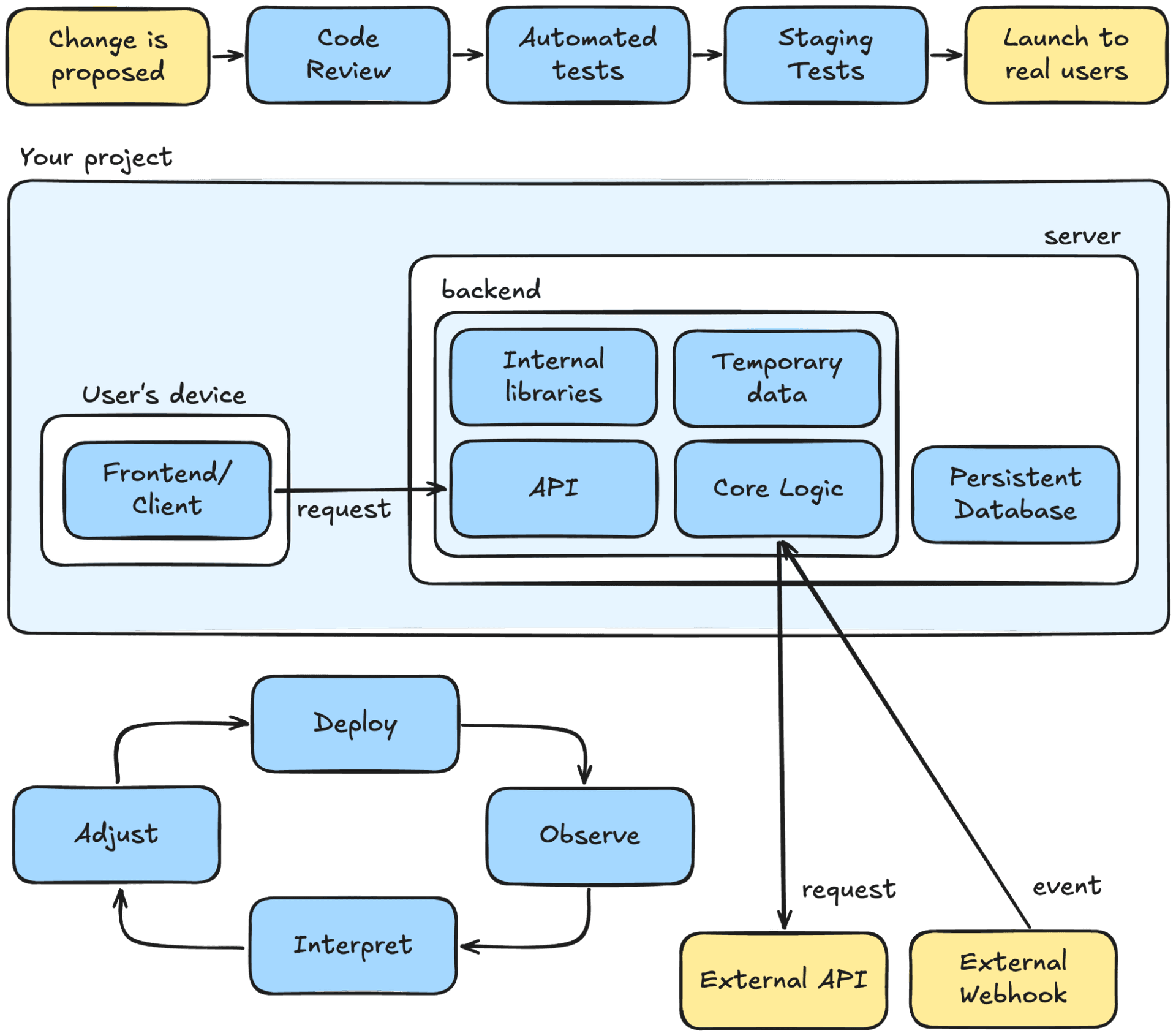
In the next chapter, we will begin by learning the mental model of software that every engineer uses. We will look at where code actually runs, what happens in your browser versus on a server, what an API truly represents, where data is stored, the basics of security, and which pieces lie behind your vibecoded project.
After that, we will examine how systems fail — not in abstract theory, but in the kinds of ways real products experience outages and inconsistent behavior. You will see why small changes can have disproportionate consequences, and why the way components are connected matters more than it seems at first.
Then we will explore how professional engineers think when they design systems. What are they optimizing for beyond “it works”? Why do they care about future maintenance, testing, review processes, and deployment strategies? Why are they cautious about quick fixes that appear harmless?
We will also look at how teams reduce risk before shipping changes, and how they understand what is happening after a system is deployed. Logs, metrics, monitoring — these are not advanced topics reserved for large companies. They are the basic tools that allow engineers to see how their systems behave.
If you build with AI long enough, you will encounter all these ideas sooner or later. The question is whether you encounter them during a crisis, or whether you approach them with at least some basic preparation.
Chapter 1 Takeaways
●Functionality ≠ Robustness: Getting a feature to work is a surface-level victory. Robustness is about how the system survives when reality deviates from the “happy path.”
●The Assumption Gap: AI tools solve the problem you explicitly describe, but they inherit all the assumptions you forget to state (about user behavior, network reliability, and external service consistency).
●The Reality of Production: Real-world usage—slow networks, impatient users, service outages—is not the same as tests on your computer. Software must be designed to handle the messy reality outside of ideal conditions.
●Complexity Compounds: A system that is stable at low usage is not automatically stable as it grows. Small, unstated assumptions accumulate over time, eventually leading to failures that are difficult to trace.
●Visibility is Key: Early success often hides future failure modes. The goal is not to predict every possible crash, but to recognize that the invisible structure beneath your “working” code is what determines whether your system survives when things go wrong.
Liked what you read? That was the first chapter of six.
- Instant download, sent via email
- 7-day money-back guarantee
- Free lifetime updates
Secure payment via Hotmart · Card, PayPal & more
Still have questions? Check the FAQ